WhatsApp automation for Indian businesses: a practical guide
WhatsApp automation for Indian businesses: how to capture, reply to, nurture and qualify leads on WhatsApp automatically, what it costs, and how to start.
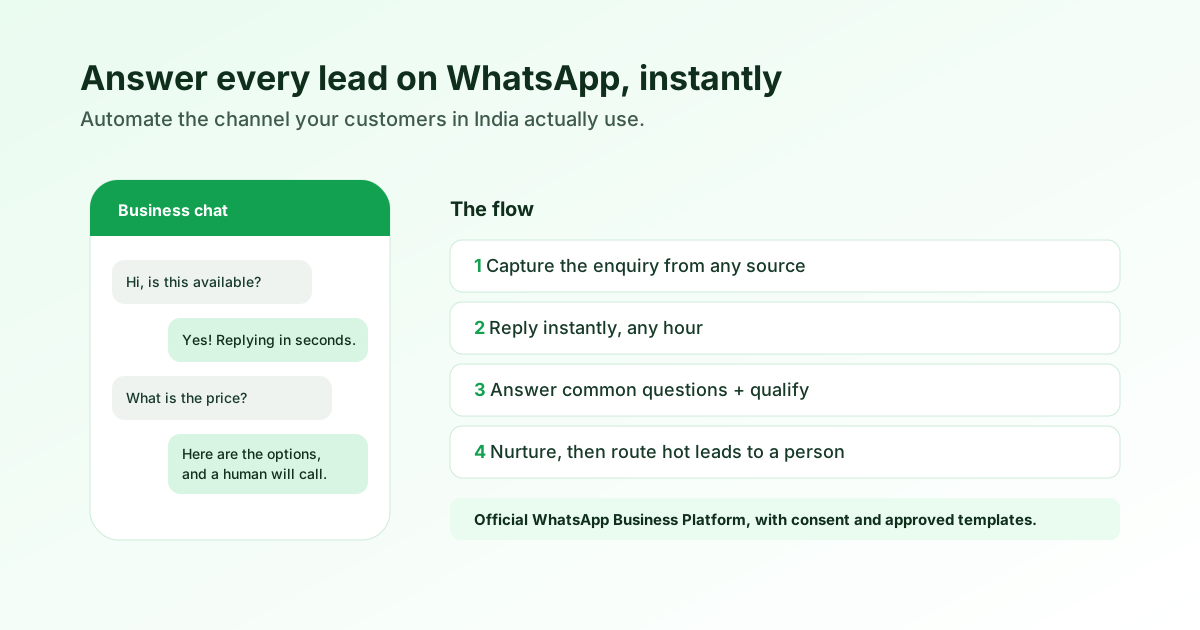
WhatsApp automation lets an Indian business respond to every enquiry in seconds, at any hour, without a human watching the phone, and it works because WhatsApp is where your customers already are. Done properly, it captures leads from every source into WhatsApp, replies instantly, answers common questions, nurtures people who are not ready yet, qualifies leads, and routes the hot ones to a real person to close. The key is doing it on the official WhatsApp Business Platform, with consent and approved templates, so it is fully allowed and never feels like spam. For most Indian businesses, this is the single highest-impact channel to automate, because it is the one customers actually use.
This guide covers what WhatsApp automation can do, how it works, what it costs, the rules to stay compliant, and how to start without overcomplicating it.
Key takeaways
- WhatsApp is where Indian customers already are, which makes it the highest-impact channel to automate.
- Real automation runs on the WhatsApp Business Platform (the API), not the basic free app.
- Instant, automated first replies win leads you would otherwise lose to slow response.
- Stay compliant: get consent, use approved templates, and never blast unsolicited messages.
- Keep a human in the loop for real conversations; automate the repetitive parts around them.
Why WhatsApp is the channel to automate in India
In India, WhatsApp is not one channel among many; for huge numbers of customers it is the default way to talk to a business. People who will not open an email or answer an unknown call will happily reply on WhatsApp within minutes. That is why automating it matters more here than almost anywhere: you are automating the channel your customers actually prefer, so every improvement compounds.
The core value is speed and coverage. Enquiries arrive at all hours from your website, ads, and social, and a human cannot reply instantly to all of them around the clock. Automation can, acknowledging every enquiry in seconds and keeping the conversation alive until a person takes over. This is the same speed-to-lead principle behind all good marketing automation and lead follow-up, applied to the channel where, in India, it matters most.
What WhatsApp automation can actually do
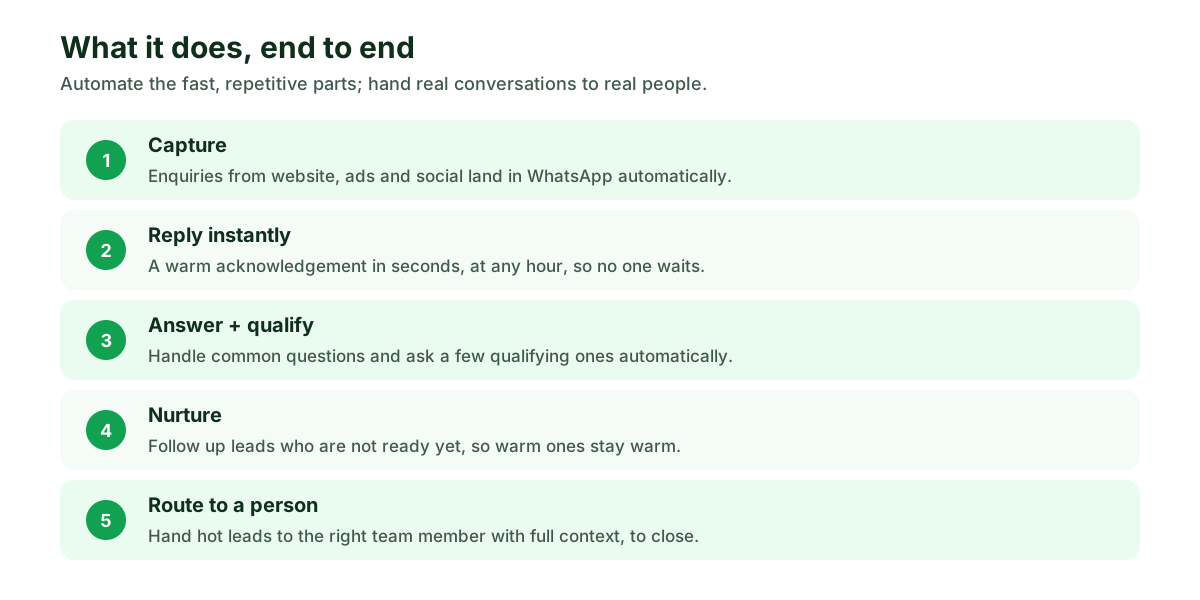
WhatsApp automation is more than an auto-reply. A proper setup covers a full flow:
- Capture. Enquiries from your website, ads, and social land in WhatsApp automatically, and a click-to-WhatsApp button or ad turns interest into a conversation instantly.
- Reply instantly. Every new message gets an immediate, warm acknowledgement, so no one waits, even at midnight.
- Answer common questions. A simple flow or chatbot handles the repetitive questions, pricing, location, hours, availability, so your team is not answering the same thing fifty times a day.
- Qualify and nurture. The automation can ask a few qualifying questions and, for people who are not ready, send helpful follow-ups over days so warm leads stay warm.
- Route to a person. When a lead is hot or the conversation needs judgement, it hands over to the right team member with full context, so people spend their time closing, not chasing.
The art is blending automation and humans: automate the fast, repetitive parts, and hand real conversations to real people at the right moment. That balance is what makes it feel helpful rather than robotic.
How it works: the Business app vs the Platform (API)
There are two very different things called WhatsApp for business, and the distinction matters. The free WhatsApp Business app is fine for a very small operation: it offers basic greeting messages, away messages, and quick replies, all handled manually on a phone. It does not connect to your other systems or scale.
Real automation runs on the WhatsApp Business Platform, often called the API, which is what powers everything above: connecting to your CRM, sending approved template messages at scale, running chatbots, routing conversations, and integrating with the rest of your funnel. You access it through an official provider rather than a phone app. Meta’s own WhatsApp Business Platform documentation is the authoritative reference for what it can do. If you are serious about automating WhatsApp, the Platform is the foundation; the free app is only a starting point for the very smallest businesses.
What it costs
WhatsApp automation has two cost layers, and understanding both keeps your spend predictable. The first is the platform or provider fee, the software that runs your automation, which varies by provider and features. The second is WhatsApp’s own charges: the WhatsApp Business Platform prices per conversation, with rates that differ by conversation type and are periodically updated, so your bill scales with how much you message.
For most small and mid-sized Indian businesses, the total is modest relative to the value, because the leads recovered by instant response and reliable follow-up typically dwarf the cost. The thing to manage is message volume: heavy, untargeted broadcasting drives up the per-conversation charges, so design your flows to be useful and relevant rather than noisy. Well-designed automation that talks to the right people at the right moments keeps costs low and value high, which is the whole point.
Staying compliant (and not getting banned)
A common fear is that automating WhatsApp will get your number banned. It will not, if you do it properly on the official platform and follow the rules. Three principles keep you safe. First, consent: only message people who have opted in or genuinely started a conversation with you. Second, templates: business-initiated messages must use message templates approved by WhatsApp, which keeps messaging legitimate and non-spammy. Third, relevance: send useful, wanted messages, not unsolicited blasts.
Businesses get restricted almost entirely because they use unofficial, unauthorised tools or blast unsolicited marketing to people who never opted in, not because they automate on the official platform. Do it the right way, with consent and approved templates through the WhatsApp Business Platform, and automation is not just allowed, it is exactly how WhatsApp intends businesses to operate at scale. Compliance here is not a constraint to work around; it is what keeps the channel trustworthy and your number healthy.
How to start without overcomplicating it
The mistake is trying to build an elaborate chatbot on day one. Start with the single highest-impact automation and expand from there. For almost every business, that first step is instant lead response: the moment an enquiry arrives on WhatsApp, from any source, it gets an immediate, warm acknowledgement and, if hot, a fast handover to a person. This one flow stops you losing leads to slow response, and it can be live quickly.
From there, layer on the next most useful pieces: automated answers to your most common questions, a simple qualifying flow, and follow-up sequences for leads who go quiet. Build in the order of impact, prove each step works, and expand only as far as genuinely helps, rather than automating for its own sake. This staged approach is the same build order we recommend in our guide to marketing automation for Indian SMBs, applied to WhatsApp: quick win first, then compound.
Common use cases by business type
WhatsApp automation looks a little different depending on what you sell, so it helps to picture it concretely. A local services business (a clinic, salon, coaching centre) uses it to answer availability and pricing instantly, book appointments, and send reminders that cut no-shows. A retailer or D2C brand uses it to answer product and stock questions, share catalogues, recover abandoned carts, and send order updates. A B2B or high-ticket business uses it to qualify enquiries fast, book calls, and keep prospects warm with useful follow-ups over a longer sales cycle. An education or events business uses it to handle admissions or registration questions and nudge people through the sign-up steps.
The common thread across all of them is the same: instant response to the first message, automated handling of the repetitive questions, and a clean handover to a human when the conversation gets real. The specifics of the flow change with the business, but the value, no lead ignored and no hour wasted on repetitive replies, is universal. Seeing your own business in one of these patterns is usually the quickest way to know where to start.
The mistakes to avoid
A few missteps turn WhatsApp automation from an asset into an annoyance. The first is over-automating: forcing every customer through a rigid bot with no easy way to reach a human, which frustrates people and costs you sales; always offer a fast path to a person. The second is broadcasting to people who never opted in, which is both non-compliant and a great way to get your number reported. The third is a robotic, template-heavy tone that feels nothing like your brand; write your automated messages to sound human and warm. The fourth is treating WhatsApp as a silo disconnected from your CRM and team, so conversations get lost and context is missing. The fifth is building an elaborate flow before proving the simple one works. Avoid these and your automation feels like fast, friendly service rather than a wall of robot messages, which is the whole difference between customers loving it and resenting it.
Where it fits with the rest of your funnel
WhatsApp automation works best when it is not a silo but part of your whole system. The conversations it starts should flow into the same CRM as every other lead, so nothing is lost and you can see the full picture; the qualifying data it gathers should inform your follow-up and your sales team; and the patterns it reveals, what people ask, where they drop off, what converts, should feed your broader decision intelligence. Connected this way, WhatsApp becomes the fast, human front door to a funnel that captures, nurtures and measures every lead, rather than a clever but isolated auto-reply. That integration is what turns WhatsApp automation from a neat feature into a genuine growth engine, because every conversation makes the rest of your marketing smarter.
Where to start
If enquiries are slipping through the cracks on WhatsApp, or your team is drowning in repetitive replies, that is exactly what automation fixes, and it is usually the highest-return channel to start with in India. Our free audit looks at how you currently handle WhatsApp and shows the single automation that would recover the most leads, before you commit to anything. From there, our marketing automation work sets it up properly on the official platform, compliant and connected to your funnel, as part of the broader Automate work that makes sure every lead gets answered fast.
Frequently asked questions
It is using the WhatsApp Business Platform to handle repetitive messaging automatically: instantly acknowledging new enquiries, answering common questions, sending reminders and follow-ups, qualifying leads, and routing hot ones to a person. It lets you respond in seconds at any hour without a human watching the phone, while still handing real conversations to your team.
For anything beyond basic quick replies, yes. The free WhatsApp Business app offers simple greetings and away messages, but real automation, connecting to your CRM, sending template messages at scale, chatbots and routing, runs on the WhatsApp Business Platform (the API), usually through a provider. That is what makes proper automation possible.
There are two parts: the platform or provider fee for the automation software, and WhatsApp's own per-conversation charges, which vary by conversation type. For most small and mid-sized Indian businesses the total is modest relative to the leads recovered, but plan your message volume so costs stay predictable rather than ballooning with heavy broadcasting.
It is fully allowed when done through the official WhatsApp Business Platform and within WhatsApp's policies: get consent to message people, use approved message templates for business-initiated messages, and do not spam. Businesses get restricted when they use unofficial tools or blast unsolicited messages, not when they automate properly on the official platform.
Want this done for you?
Yovance is an AI growth and automation studio. We can put this into practice for your business.