Why your website gets traffic but no leads (and how to fix it)
Why your website gets traffic but no leads: the real conversion killers, from unclear offers and slow pages to weak CTAs and no follow-up, and how to fix each.
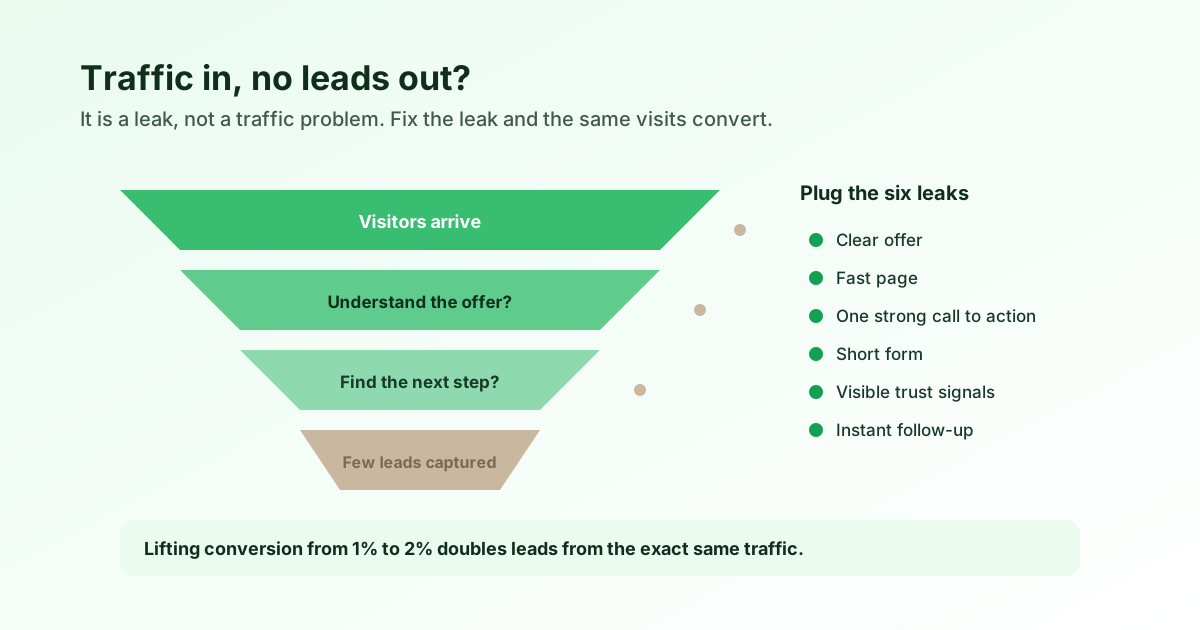
If your website gets traffic but no leads, the problem is almost never that you need more traffic. It is that visitors are leaking out at a conversion step: an unclear offer, a slow or confusing page, a weak call to action, a form that asks too much, missing trust signals, or no follow-up on the few leads you do capture. Sending more traffic to a leaking page just wastes more visits. Fix the leak and the same traffic you already have starts turning into leads. Conversion is a clarity-and-friction problem, not a traffic problem.
This guide covers the real reasons websites fail to convert, how to diagnose which one is hurting you, and how to fix each, so the visitors you are already paying for or earning actually become leads.
Key takeaways
- Traffic without leads is a conversion problem, not a traffic problem. Fix the leak first.
- The usual killers: unclear offer, slow page, weak CTA, long form, no trust, no follow-up.
- Make one thing obvious: what you offer, why it matters, and the single next step.
- Improving conversion usually beats buying more traffic, because it lifts every visit.
- Capture and follow up every lead instantly, or you leak conversions you already earned.
First: it is a conversion problem, not a traffic problem
The instinct when leads are low is to chase more traffic, but if you already have visitors and no leads, more traffic just means more wasted visits. The maths is simple and worth internalising: doubling traffic to a page that converts nobody still gives you nothing, while lifting a 1 percent conversion rate to 2 percent doubles your leads from the exact same traffic. That is why fixing conversion is almost always the higher-return move when you already have visitors, and it directly lowers your customer acquisition cost because every existing visit starts to pay off.
So before spending another rupee on ads or SEO, find out where your existing traffic is leaking. It is nearly always one or more of the six killers below, and each is fixable. This is the thinking behind our conversion website work: make the traffic you already have convert before pouring more into the top.
The six conversion killers
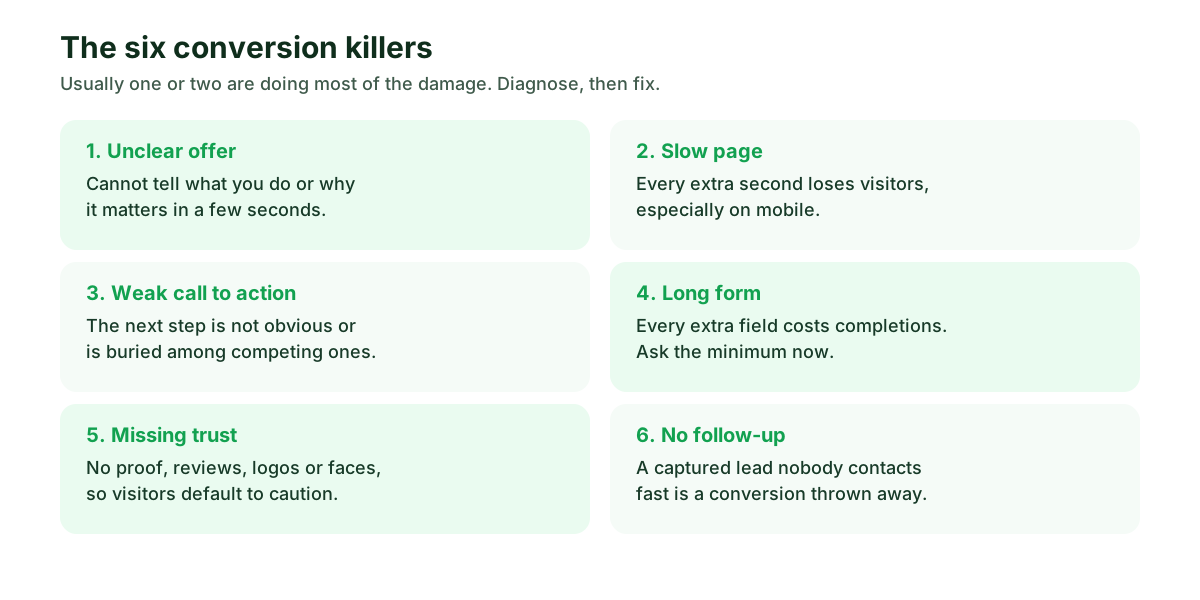
Diagnose your site against these six. Usually one or two are doing most of the damage.
- An unclear offer. If a visitor cannot tell within seconds what you do, who it is for, and why it is worth it, they leave. Confusion is the biggest silent killer of conversion.
- A slow or clumsy page. Speed is conversion. Every extra second of load time costs you visitors, especially on mobile. A slow page loses leads before anyone reads a word.
- A weak or hidden call to action. If the next step is not obvious and repeated, visitors do not take it. One clear primary action beats five competing ones.
- A form that asks too much. Every extra field costs conversions. Ask for the minimum you need now, and get the rest later in the conversation.
- Missing trust signals. People do not act when they are unsure they can trust you. No proof, reviews, logos or real faces means no confidence, and no confidence means no lead.
- No follow-up. Even when you capture a lead, if nobody responds fast, you lose it. Capture without follow-up is a leak at the very end of the funnel.
Killer 1 and 3: clarity of offer and call to action
The two most common and most fixable killers are clarity of offer and clarity of the next step, so tackle them first. Within a few seconds of landing, a visitor should be able to answer three questions: what do you offer, why should I care, and what do I do next? If any of those is unclear, they leave. The fix is ruthless simplicity: a headline that states the offer and its benefit in plain words, supporting copy that speaks to the visitor’s problem, and one obvious primary call to action repeated down the page.
Resist the urge to say everything. A page trying to appeal to everyone and offer every service converts worse than a focused page with one clear offer and one clear next step. Nielsen Norman Group’s decades of usability research, summarised across their articles on web usability, keep returning to the same lesson: users scan, they do not read, and clarity beats cleverness every time. Make the offer and the action impossible to miss and you fix the biggest leak on most sites.
Killer 2: speed and friction
A beautiful page that loads slowly converts badly, because most visitors will not wait, and the cost is highest on mobile where much of your traffic now is. Page speed is not a technical nicety; it is a direct conversion factor. Google’s own work on Core Web Vitals ties loading speed, responsiveness and visual stability directly to whether users stay and act, and slow or janky pages measurably lose conversions.
Beyond raw speed, remove friction everywhere: no confusing navigation, no pop-ups that block the content, no broken mobile layouts, no unnecessary steps between interest and action. Every point of friction is a place visitors drop out. The goal is a fast, calm, obvious path from landing to the next step, with nothing in the way. Often, simply fixing speed and stripping friction lifts conversion noticeably before you change a single word of copy.
Killer 4 and 5: form length and trust
These two work together, because both are about lowering the perceived cost of acting. On forms, every field you add reduces completion, so ask only for what you genuinely need at this stage, often just a name and one contact method, and gather the rest in the follow-up conversation. A short form that gets completed beats a thorough form that gets abandoned.
On trust, people do not hand over their details to a business they are unsure about. Visible proof lowers that risk: genuine reviews and testimonials, recognisable client logos, real photos of real people, clear contact details, and any credentials that matter in your field. The absence of these signals quietly kills conversion because visitors default to caution. Add credible proof near your calls to action and forms, exactly where hesitation happens, and more visitors take the step.
Killer 6: no follow-up
The cruelest leak is at the very end: you did everything right, the visitor became a lead, and then nobody followed up fast, so they went to whoever did. A captured lead that sits uncontacted is a conversion you earned and then threw away. Speed of response is decisive here, and it is impossible to guarantee by hand at all hours.
The fix is to wire instant, automated follow-up to every lead your site captures, so each one gets an immediate acknowledgement and a fast, human next step, and nothing falls through the cracks. This closes the loop between your website and your pipeline, and it is exactly what automating lead follow-up through marketing automation delivers. A converting website and instant follow-up together are far more powerful than either alone.
Mobile is where most of the leak happens now
It is worth calling out mobile specifically, because for most businesses the majority of traffic is now on phones, and that is where conversion quietly breaks. A page that looks fine on your laptop can be a disaster on a phone: tiny tap targets, forms that are painful to fill, text that requires zooming, calls to action pushed below several screens of content, and load times that are far slower on mobile networks. If you diagnose your site only on a desktop, you will miss the leak that is costing you the most.
The fix is to treat mobile as the primary experience, not an afterthought. Test every page on an actual phone on a normal connection, time how long it takes to understand the offer and reach the call to action, and fix whatever is slow or fiddly. Because so much traffic is mobile, a mobile conversion improvement often moves your overall numbers more than any desktop tweak, and it is frequently the single highest-return fix available.
A worked example: same traffic, more leads
Consider a business getting 5,000 visits a month and converting 1 percent, so 50 leads. They add more ad spend to chase growth and push traffic to 7,000, lifting leads to 70 but at real extra cost. Now rewind and instead fix conversion: clarify the offer, speed up the page, add one strong call to action, shorten the form and add proof. Conversion rises from 1 to 2.5 percent. On the original 5,000 visits, that is 125 leads, more than the extra-spend path produced, with no increase in traffic cost at all. Then, with a page that actually converts, scaling traffic finally makes sense, because every new visit is now worth more. That is the whole argument for fixing the leak before opening the tap wider.
How to diagnose your own site
You do not have to guess which killer is hurting you; the data will tell you. Watch where visitors drop off: high traffic but few form views points to an offer or CTA problem; many form views but few completions points to form length or trust; leads captured but none converting points to follow-up. Simple tools like analytics and heatmaps show where attention goes and where people leave, and this kind of honest measurement is exactly what decision intelligence brings to every marketing question. Even a five-minute look at your own site on a phone, timing how long it takes to understand the offer and find the next step, reveals most problems. Diagnose before you redesign, so you fix the actual leak rather than changing things that were never the issue.
Redesign or fix? Start with fixes
A common overreaction is to commission a full website redesign when leads are low. Sometimes that is warranted, but often the specific fixes above, clearer offer, faster page, stronger CTA, shorter form, more trust, instant follow-up, lift conversion far faster and cheaper than a months-long rebuild. Start with targeted fixes to the highest-impact leak, measure the change, and only redesign if the fundamentals are genuinely broken. This keeps you improving results in weeks rather than waiting a quarter for a new site that may repeat the same conversion mistakes with nicer styling.
Where to start
If your site gets visits but not leads, the fastest win is to find the specific leak rather than guessing or rebuilding. Our free audit reviews your site against the six killers and shows exactly where your traffic is leaking and which fix will recover the most leads, before you commit to anything. From there, our conversion website work turns your site into one that actually converts, wired to instant follow-up, as part of the broader Automate work that makes every visit and every lead count.
Frequently asked questions
Almost always because the traffic is leaking at a conversion step, not because you need more of it. The usual culprits are an unclear offer, a slow or confusing page, a weak or hidden call to action, asking for too much too soon, a lack of trust signals, or no follow-up on the leads you do capture. Fix the leak and the same traffic starts converting.
Make one thing obvious: what you offer, why it is worth it, and the single next step. Then remove friction: a fast page, a clear call to action above the fold, a short form, and visible proof. Finally, capture and follow up every lead instantly. Conversion is about clarity and friction, not clever tricks.
It varies widely by industry and traffic quality, but many B2B and service sites convert somewhere in the low single digits of visitors into leads. The more useful number is your own trend: measure where visitors drop off and improve it. Even a small lift in conversion rate is often worth more than a large increase in traffic.
If you already have traffic that does not convert, improving conversion is almost always the better first investment. More traffic to a leaking page just wastes more visits, whereas fixing conversion makes every existing and future visit worth more. Get the page converting first, then scale traffic into it.
Want this done for you?
Yovance is an AI growth and automation studio. We can put this into practice for your business.